I'm finally killing Freddy Krueger and Jason Voorhees once and for all this afternoon: I'm finishing my month-long horror-movie marathon. What kind of content will this site have once I'm done? Hell if I know.
 Wes Craven's New Nightmare
 is the final movie in the
Nightmare series proper, and what a fitting send-off it is. The film takes the tired
Elm Street formula and turns it on its head, creating one of the scariest films in the franchise (second only to the original).
The conceit of this film is that we are now in the REAL world. The actress who played Nancy in the first and third installments is back, but this time she is playing the actress who played Nancy. Robert England (nee Freddy Krueger) appears in the flesh, as does director Wes Craven. Nancy...er...Heather is haunted by dreams (not to mention creepy phone calls) that Freddy has become real. The reasoning is well thought out (at least for a movie that involves multiple impalings).
Freddy
is back--kind of--although it's not the same Freddy we've come to know and loathe in the five prior sequels. This Freddy doesn't have time for quips, video games, or pizza pies. Garbed in a new, black trenchcoat, he's all business, and he's scary as hell. Given the new level of gravitas in this film, I'm reasonably satisfied despite the minimal amount of gore and death.
Sure, one man is slashed across the chest. And another is given the same treatment as Nancy's friend in the first film. But the only really inventive sequence isn't actually a kill at all. Heather's child is attempting to cross the freeway in a surprisingly-well-filmed and intense scene, and Freddy dangles the boy above cars in front of his frightened mother's eyes.

That's right. For the first time, Krueger does what he was meant to do: he haunts and attempts to kill a child. While child actors have a tendency to virtually suck the life out of any movie in a hurry (see:
The Lost World: Jurassic Park;
The Phantom Menace;
The Mummy Returns, etc.),
New Nightmare remains unscathed and actually benefits from the talent of its creepy little bugger. Of course, this is partially due to the kid in question: precocious
Full House smartass and
Kindergarten Cop know-it-all Miko Hughes. Boys have a penis and girls have a ba-gina indeed, Miko.
New Nightmare is a more-than-fitting end to the
Elm Street series, and it's a shame that some schlub goalie is about to make Freddy Krueger his bitch.

We have had many epic battles in our time--Tyson vs. Holyfield; Brown vs. the Board of Education--but none were quite so gloriously bloody as
Jason vs. Freddy, the ultimate horror clash (until they find a way to work Michael Myers in there). Freddy has been dormant for four years because everybody has forgotten about him, so he culls Jason Voorhees from the depths of hell in order to wreak chaos and inspire fear on Elm Street until we have approximately forty-too-many words of exposition without any blood splatter.
As a film,
Vs. is not exactly high art (even by the standards of the ten
Fridays and seven
Nightmares). The last ten minutes of this film alone contains more blood and gore than any of the predecessors' entire movies. And I wouldn't have it any other way.
Really,
Freddy vs. Jason is the best of both worlds. You have the brute-strength slaughters of the inimitable Mr. Voorhees, but you also get the creepy, dreamlike maulings of our man Krueger. In other words, if you're tired of somebody's face being eaten by a giant, pot-smoking caterpillar, you won't have to wait long for somebody to get stabbed in the torso fifteen times and folded in half by a cot.
There are a couple of "OH YEAH!" moments in the film, and they all belong exclusively to Jason. What can I say? I'm a gore fella. Weirdly, I think I enjoy the
Nightmare series more as a whole, but there's no number of shitty one-liners that can have the same effect as the strong, silent type shoving a flaming machete through your chest with naught but the flick of a wrist. Anyway, Jason gets a fair number of said machete-slayings (as well as the aforementioned "stabbing a guy fifteen times and closing the cot on him"), but he gets to do some other cool stuff. He breaks a guy's neck so fast that the head seems to spin 720 degrees. And of course, no good Jason movie would be complete without somebody literally being chopped in half.
Blah blah blah. It's all unimportant, because the final half hour becomes the promised main event. The spawn of Satan versus the killer from Crystal Lake. Freddy vs. Jason. I've never seen a movie offer up so much gratuitous blood and sinew. Ever. Each of the characters gets hacked and slashed at least thirty times, and the flesh is flyin'. If you don't like spoilers, look away now: Freddy gets his ass handed to him by Jason. OR DOES HE? Well, yeah. He really does. Unless Freddy is going to kill you with his winking, disembodied head, Jason wins by means of retaining some of his limbs.
Thanks to everyone for reading. Thanks to Freddy Krueger for putting the "laughter" in "slaughter," and thanks to Jason Voorhees for putting the "machete" in "pretty much everybody."


 Wild At Heart is among Lynch's more linear pieces, and this is probably because it's based on a novel (Wild at Heart: The Story of Sailor and Lula by Barry Gifford). There tends to be a pattern to Lynch's work: if it springs entirely from his mind, it is an iconic and often wholly incomprehensible Lynch piece (see: Blue Velvet and Mulholland Drive, among others). When the work is based on another piece--whether it be a real-life occurrence or a novel--it is easier to follow, yet still marked with Lynch's fingerprints (see also: The Straight Story, The Elephant Man).
 The most incomprehensible (and yet the least Lynchesque) element of the film is the allusion to The Wizard of Oz. I've very infrequently seen Lynch reference other films within his own work. Certainly, he pays due to famous starlets of the golden age of cinema, but other narratives seem to have been off-limits. However, The Wizard of Oz is all over this piece. Lula (played by Laura Dern) references her homicidal mother as the Wicked Witch. Lula recalls her mother's cackle as her father was murdered. She sees an eerie, broom-riding specter following her car. In the end, Lula even vanquishes her mother's influence by tossing water onto a photograph of her (which shortly thereafter disappears, steaming). After a particularly brutal scene of sexuality involving Willem Dafoe's character Bobby Peru, Lula clicks the heels of her red slippers, almost in a cry to return to a place she could be comfortable. When that reprieve doesn't come, she slumps into a ball in the motel room. It is almost as if Lula lives her life in the fantasy world of Oz in an attempt to come to terms with all of the terrible things that had happened to her. In the end, it is only fitting that she is saved by the Good Witch.
 The movie I remembered was, obviously, Silver Streak. I'm typically a sucker for anything Gene Wilder, and Silver Streak is no exception. This is the first time I've seen the movie in full, and it didn't quite live up to my expectations. But how could it? Gene Wilder! Richard Prior! A murder mystery! A train! Hearing the premise on the back of the box made me think of Hitchcock's near-perfect thriller, Strangers on a Train. They even wanted me to think it! Here, listen:
 One of my favorite parts of the movie, upon first watching, probably wasn't meant to be funny. There is a scene at the beginning in which the female lead hits on Gene Wilder unsolicited, coming on in a way that is so unbelievably strong that you really believe she thought to herself, "There is something about that man and his untameable Jew-fro mane that just makes me want to SEX that." There's definitely a chemistry between the two actors, which is nice to see in something like a late seventies comedy caper (and would be nice to see in modern romances).
 In the continued effort to view every DVD on my shelf, I had a The Ren and Stimpy Show marathon today. I've been meaning to watch this box set since Halloween ended, but every time I tried to pop the first disc of Seasons Three and a Half-ish, I fell asleep. Finals week was the perfect time to sit down and watch DVDs, because I don't study and I literally had nothing to do for days at a time.
 A lot of to-do is made about John K.'s eviction from the show, and it was a travesty. However, I can see no marked decline in quality from the first box set to the second. John K. was revolutionary in his animation and in his twisted premises, but Bob Camp and the rest continue that tradition equally well. The animation is beautiful, and the inventiveness the animators have in creating expressions for the characters is the best since the golden years of Warner Bros. cartoons, and remains unrivaled by anything since.
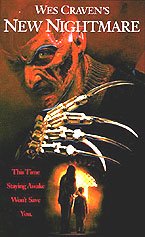 Wes Craven's New Nightmare is the final movie in the Nightmare series proper, and what a fitting send-off it is. The film takes the tired Elm Street formula and turns it on its head, creating one of the scariest films in the franchise (second only to the original).
 That's right. For the first time, Krueger does what he was meant to do: he haunts and attempts to kill a child. While child actors have a tendency to virtually suck the life out of any movie in a hurry (see: The Lost World: Jurassic Park; The Phantom Menace; The Mummy Returns, etc.), New Nightmare remains unscathed and actually benefits from the talent of its creepy little bugger. Of course, this is partially due to the kid in question: precocious Full House smartass and Kindergarten Cop know-it-all Miko Hughes. Boys have a penis and girls have a ba-gina indeed, Miko.
 We have had many epic battles in our time--Tyson vs. Holyfield; Brown vs. the Board of Education--but none were quite so gloriously bloody as Jason vs. Freddy, the ultimate horror clash (until they find a way to work Michael Myers in there). Freddy has been dormant for four years because everybody has forgotten about him, so he culls Jason Voorhees from the depths of hell in order to wreak chaos and inspire fear on Elm Street until we have approximately forty-too-many words of exposition without any blood splatter.
 In A Nightmare On Elm Street, Part 5: The Dream Child, Freddy is born again via the various bodily oozes of our surviving characters from its predecessor, The Dream Master. We see him emerge from his mother's womb a scarred and disfigured demon child (the doctor's understandable first words: "Holy shit!"). And then he haunts the dreams of The Dream Master's unborn fetus.
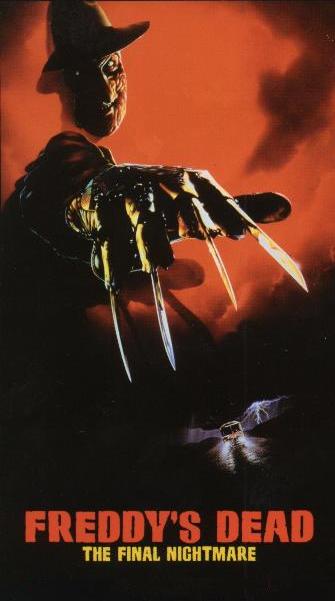 Freddy's Dead: The Final Nightmare! Wow! There's no way he can make it out of this one alive!